How to Read a College Soccer Roster Before You Email the Coach
Ninety's Roster Analysis breaks down any college soccer roster by position and class year, shows where spots are opening, and scores how hard it may be to earn one.
 Beau5 min read

Most players pick schools to email by name, by logo, or by where their friends are going. Almost nobody looks at the roster first. That's a mistake, because the roster tells you something every coach is thinking about but rarely says out loud: do we need a player like you?
A coach who has nine midfielders and only three of them are leaving isn't looking very hard for midfielders. A coach who's losing four center backs at once is. Same school, same coach, completely different chance.
That's why we built Roster Analysis into Ninety.
What Roster Analysis Does
Open any college in Ninety and go to the Roster tab. Click Analyze roster, and we read the program's current roster from the school's athletics site. In a few seconds you get:
- How many players are on the team, and how many are graduating
- Where spots are opening, by position
- A breakdown by position and by class year, so you can see if a team is young or old
- A roster difficulty score from 1 to 10
- "What this means for you", a few plain sentences about your chances, based on your position and grad year
Here's what it looks like:
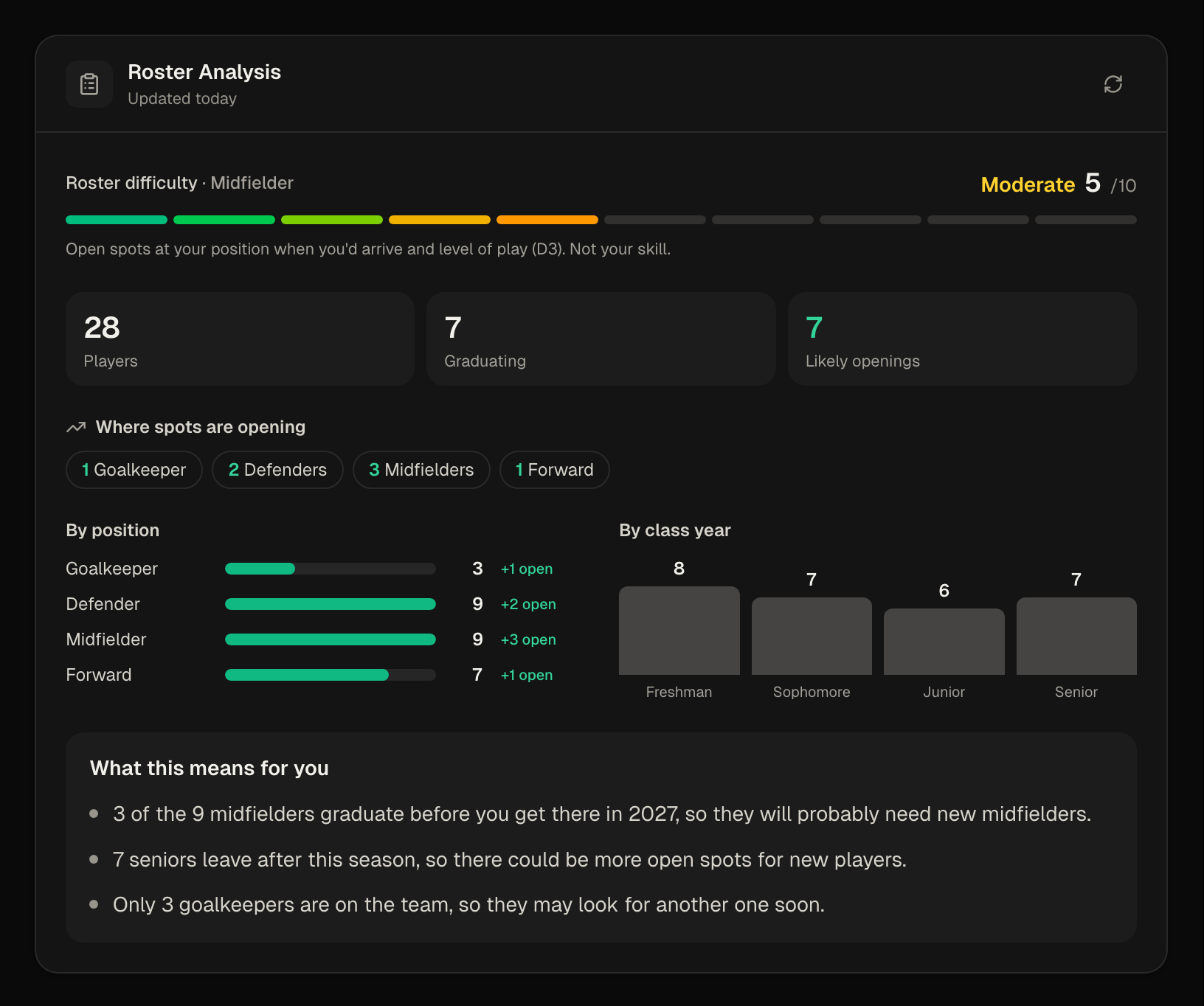
The analysis saves to that school, so you don't have to run it again every time you come back. When a new roster comes out, just hit refresh.
How to Read It
Graduating players and openings
Seniors leave every year. When they leave, the coach has to replace them. So the number of seniors at your position is the best simple signal of how many players that coach will be recruiting.
"Where spots are opening" lists them out for you. If you're a midfielder and you see 3 Midfielders, that program has a real reason to read your email.
Position and class year
This is where it gets interesting. Two teams can both have nine defenders. But if one team's defenders are mostly juniors and seniors, there will be room soon. If the other team's defenders are mostly freshmen and sophomores, those guys will be there for years.
The class year chart shows you which kind of team it is. A roster full of freshmen usually means the coach just had a big recruiting year. A roster heavy with seniors usually means a big one is coming.
Roster difficulty score
The score puts all of that into one number for your position:
- 1 to 3 is Easier. Lots of players at your position are leaving and the team will need more.
- 4 to 6 is Moderate. Some room, but you'll be competing for it.
- 7 to 10 is Tougher. The position is full of players who will still be there, or the level of play is very high.
It looks at two things. First, how many players at your position will still be on the team when you'd actually arrive. A Class of 2028 player doesn't care about this year's seniors. He cares about who's still there in the fall of 2028. Second, the level of play. D1 is tougher than D2 or D3, and the strongest D1 conferences, like the ACC, Big Ten and Big East, are tougher still.
One honest note: the score is about roster space, not about you. It doesn't know how good you are. A tough score doesn't mean you can't play there. It means you'll need to stand out more to earn a spot.
What this means for you
This is the part I'd read first. It turns the numbers into a few short sentences, written for you. Something like: "3 of the 9 midfielders graduate before you get there in 2027, so they will probably need new midfielders."
It uses the position and grad year from your Ninety profile, so make sure those are filled in.
How It Helps You Make Better Decisions
The roster won't tell you where to go to school. That should start with the school itself. But once you have a list, the roster helps you decide where to spend your time.
Decide who to email first
You only have so many hours. Start with programs where your position is opening up. Your email is a lot more likely to get read when it lands on a coach who's actively looking for what you play. If you're not sure what to say, here's how to write a first email to a college coach.
Write a better email
Coaches can tell when you've done your homework. One line like "I saw you're graduating three midfielders this year" shows you looked at their program, not just their email address. Keep it simple and don't overdo it.
Pick the right ID camps
ID camps cost real money. Before you sign up, check the roster. A camp at a school that's loaded at your position may still be worth it for the experience, but it probably shouldn't be your first choice. Here's more on how to choose the right ID camp.
Build a balanced list
You want a mix. A few tougher schools you're excited about, a bunch of moderate ones, and a few where the roster says they'll really need your position. If every school on your list scores a 9, that's a sign to add some options.
Ask smarter questions
When you talk to a coach or go on a visit, the roster gives you something real to ask about:
- "How many players at my position are you bringing in for my class?"
- "How do you see the depth chart at my position when I get there?"
- "Do freshmen get real minutes, or does it usually take a couple of years?"
Good coaches respect these questions. They show you're thinking about fit, not just an offer. Here's everything you need to know about college soccer visits.
What the Roster Can't Tell You
I want to be straight about the limits.
- Rosters change. Transfers, international players and the transfer portal can fill a spot that looked open in November.
- Not every school lists everything. Some rosters skip class years, and some list players in two positions. When that happens, the analysis tells you it's an estimate.
- Coaches recruit the best players they can find. If you're good enough, a coach will make room, even at a crowded position.
- Redshirts and fifth-year players can make a senior stick around longer than you'd think. Here's what redshirt really means.
So use the roster as a guide, not a final answer. Never cross off a school you love just because of one number.
The Bottom Line
The roster is the coach's to-do list hiding in plain sight. Reading it takes a few seconds, and it can change which schools you email, which camps you go to, and what you ask when a coach finally calls.
Roster Analysis is in every college page in Ninety, right next to the coaching staff and your contacts. Find the programs that need your position, then go make your case. Get started at go90.io.