How Many International Players Are on a College Soccer Roster? (And How to Check Any Team in Seconds)
About 1 in 3 D1 men's soccer players is international. Here's how to check the US vs. international split on any college roster, by position, and what it means for recruiting.
 Beau5 min read

In Division I men's soccer, about one in three players is from outside the United States. That's the average across the country. But averages lie. Some programs are almost all American. Others have more international players than US players. If your son is trying to get recruited, the only number that matters is the one for the schools on his list.
Here's how to find it, and what to do with it once you have it.
Why This Number Matters for Your Player
When my son started building his college list, I'd look at a roster and see a big group of guys and think, "OK, there's room." Then I started reading the hometowns. London. Madrid. Stockholm. Accra. Toronto.
That changes things. A coach who keeps filling spots with international players is telling you how he recruits. That doesn't mean your son has no shot. It means he's competing against a different pool of players, and he needs to know that before he sends an email.
Here's roughly how it breaks down by level:
- Division I: about a third of players are international, and that share has nearly doubled since 2010.
- Division II: a little higher than D1. Lots of D2 programs lean heavily international.
- Division III: much lower, around one in ten.
- NAIA: the highest of any level, close to half.
So if your son is a strong US player who keeps hearing nothing back from certain D1 or D2 programs, this could be part of the reason. And it might point him toward schools that recruit more American players.
How to Count International Players on Any Roster
You can do this yourself. It just takes some time.
- Step 1: Go to the school's athletics website and open the men's soccer roster.
- Step 2: Find the hometown column. Most rosters list "Hometown / Previous School."
- Step 3: Count the players whose hometown is outside the US.
- Step 4: Divide that by the total roster size.
Example: a roster has 30 players. 12 of them list hometowns in England, Germany, Brazil, or Canada. 12 divided by 30 is 40%. That's a program that recruits internationally a lot.
A few things to watch for:
- Canada counts as international. A lot of people forget that.
- Some players are American but played club or academy soccer overseas. Go by hometown, not previous club.
- Older rosters can tell you about trends. Check last year's roster too. Is the number going up or down?
Look at Positions, Not Just the Whole Team
This is the part most families skip, and it's the most important part.
A team can be 30% international overall, but 4 of its 5 center backs are international. If your son is a center back, that 30% number doesn't tell his story. Position by position is where the real picture shows up.
Example: your son is a goalkeeper. School A has 3 keepers, all from the US. School B has 3 keepers, and 2 are from Europe. Both schools look the same on paper. But School A has a history of recruiting American keepers. School B doesn't. That's a big deal when you decide where to spend his emails and ID camp money.
Doing this by hand means sorting every player by position and hometown. For one school, fine. For 25 schools on his list? That's a whole weekend gone.
The Fast Way: Ninety's Roster Tab
We built this into Ninety because I got tired of counting.
Every college on Ninety now has a Roster tab that shows you how many players are from the US and how many are international. You see it for the whole team and for each position. No spreadsheets. No counting hometowns at the kitchen table.
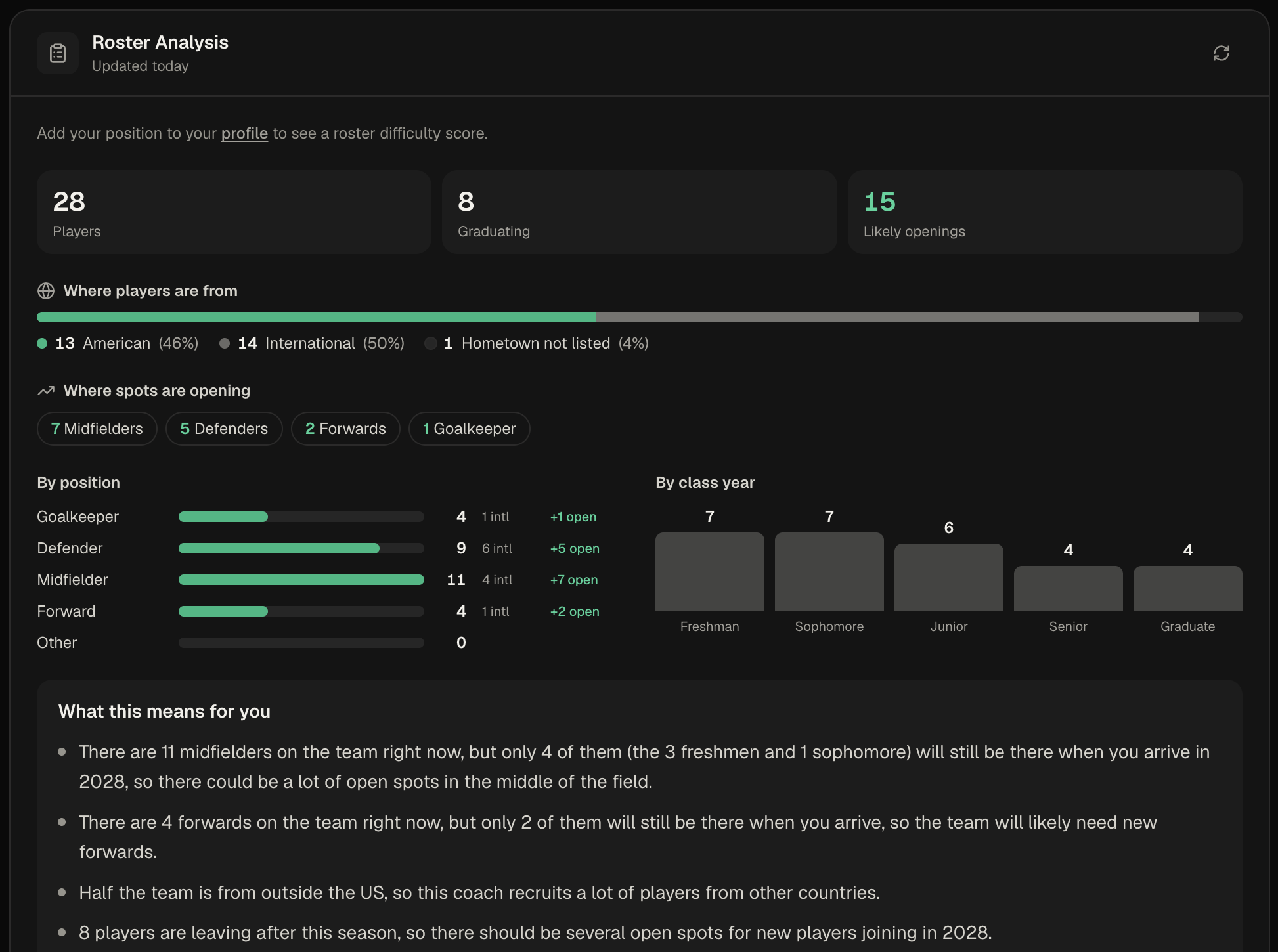
Open a school, click Roster, and in about 30 seconds you'll know:
- How international the team is overall.
- Whether your son's position is filled mostly with US players or international players.
- Whether this program is a realistic target or a long shot for him.
Do it across his whole list and you'll start seeing patterns fast.
What to Do With the Numbers
Don't cross a school off just because it has a lot of international players. Use the number to make smarter moves.
- If a school is mostly US players at your son's position, move it up. Email the coach. Get to their ID camp.
- If a school is heavy international at his position, keep it on the list, but make sure he has plenty of other options.
- If his whole list is D1 and D2 programs with high international numbers, add some D3 schools. The international share there is a lot lower, and the soccer is better than most people think.
Recruiting is a numbers game. The families who know the numbers make better choices.
Start With One School Tonight
Pick the school at the top of your son's list. Check the roster. Look at his position. You'll know more in five minutes than most families figure out in a whole season.
Want the shortcut? Open any college on Ninety at go90.io, click the Roster tab, and see the US vs. international breakdown for the whole team and every position.
FAQ
Frequently Asked Questions
How many international players are on a D1 men's soccer roster?
About one in three on average, but it varies a lot by school. Some programs are almost all American, and others have more international players than US players.
Which level of college soccer has the fewest international players?
Division III, at around one in ten. D2 is a little higher than D1, and the NAIA is the highest of any level, close to half.
How do I count international players on a roster?
Open the school's men's soccer roster, find the hometown column, count the players whose hometown is outside the US, and divide by the total roster size. Go by hometown, not previous club, and remember that Canada counts as international.
Why should I look at positions instead of the whole team?
A team can be 30% international overall but have mostly international players at your son's position. The position-by-position split shows whether a coach usually recruits American players for the spot he plays.
Should we cross off schools with a lot of international players?
No. Use the number to decide where to focus. Move schools that recruit US players at his position up the list, keep the others, and add some D3 schools if every school on his list is heavily international.